
 IT
 EN

How sensors and artificial intelligence help assess freshness
Food can look normal even when deterioration has already begun. Conversely, products that are still fit to eat are sometimes discarded as a precaution. Reducing this uncertainty calls for fast, repeatable tools that complement operators’ experience with measurable data.
An electronic nose detects the volatile substances released by food and turns them into digital information. Combined with artificial intelligence, it can support more timely checks and more precise product management, helping to reduce waste.
How it works
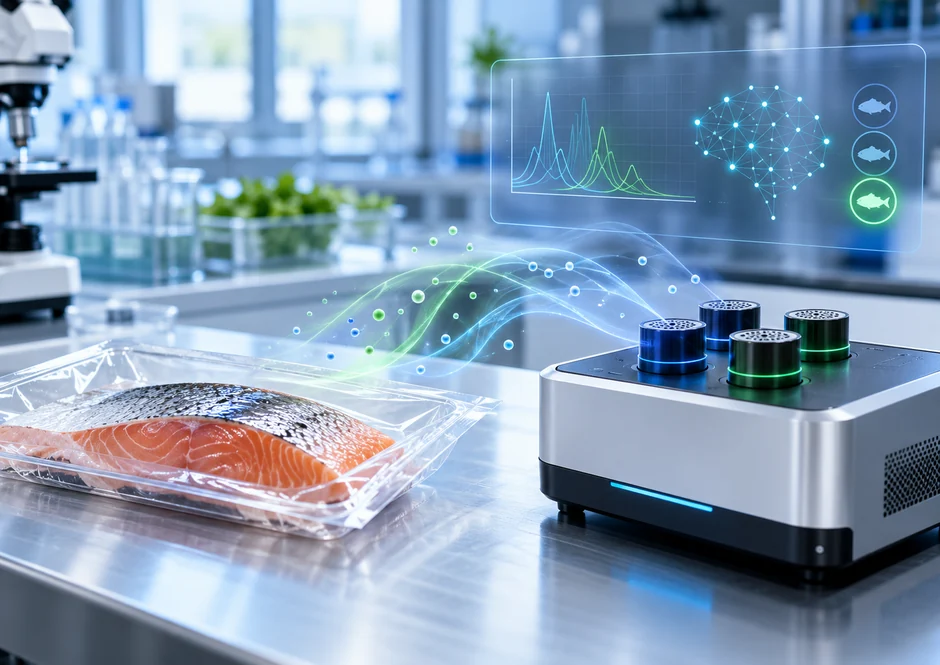
An electronic nose, or e-nose, combines chemical sensors and software. The sensors react to molecules in the air around a sample: together, their signals form a digital olfactory fingerprint that can be correlated with quality and storage condition.
MasterSense, developed by Senior, uses four metal oxide semiconductor (MOS) sensors to detect families of volatile compounds released by meat and fish. The combined responses allow the sample to be classified as unspoiled, acceptable or degraded.
From signals to a clear result
The hardware collects signals, while algorithms interpret their combinations. During development, the system is trained on samples with a known freshness status. When it analyses a new food sample, it compares its profile with those it has learned and provides a result that helps the operator decide whether further checks or corrective measures are needed.
Compared with human sensory assessment alone, which is influenced by experience, sensitivity and fatigue, an instrument can apply repeatable criteria, record results and compare them over time. Its role is to support screening: it does not automatically replace laboratory analyses or procedures required by regulations.
Support throughout the supply chain
Potential applications span processing, logistics, retail and institutional catering. An electronic nose can complement checks on raw materials, flag storage anomalies and help manage stock. More frequent measurements allow problems to be identified earlier and provide useful information for improving transport and storage.
Reducing waste does not mean indiscriminately extending product life. It means making better-informed decisions: identifying products that need attention, prioritising stock approaching its limit and reducing precautionary discards, while keeping safety as the guiding principle.
From freshness to traceability
Connecting measurements to cloud platforms, mobile applications and management software enables historical records to be built, data to be shared with authorised users and alerts to be generated. This vision also underpins Shelfmate, a research and development project led by Senior that integrates an electronic nose, artificial intelligence and blockchain to monitor quality and freshness throughout the supply chain.
What reliable results require
Effectiveness depends on representative samples, consistent measurement procedures, calibration and maintenance. Models also need ongoing validation against reference methods. The device must therefore operate within a quality system with clear protocols and trained personnel.
Through MasterSense and projects focused on traceability, Senior works to turn an odour that is difficult to describe into information that can be compared. The practical value is to help companies check products more effectively and reduce waste through decisions supported by data.